FAQ : About Detectors/Test Kits
This section explains everything you need to know About RADON Detectors and Test Kits - how they work, how to use them correctly, and how to interpret the results.
You’ll learn the difference between short-term and long-term testing, the importance of accurate placement, and how professional testing compares with DIY test kits.
Our goal is to help you choose the right RADON test kit, follow Health Canada’s testing guidelines, and understand your RADON results with confidence.
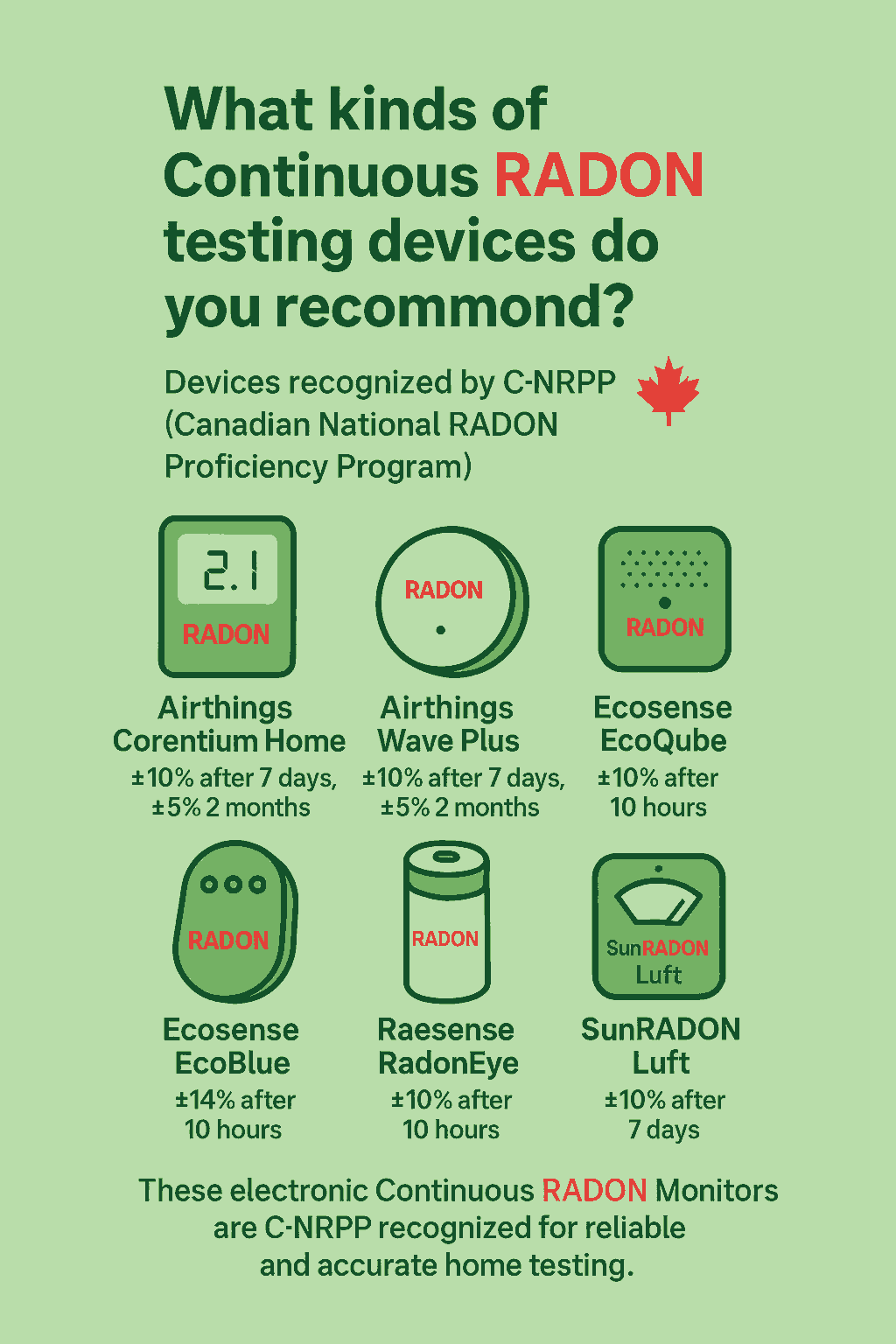
There are several reliable electronic Continuous RADON Monitors available for home use.
We recommend Airthings devices and other models recognized by the C-NRPP (Canadian National RADON Proficiency Program) for their accuracy and performance.
Our goal is to help you choose the right RADON test kit, follow Health Canada’s testing guidelines, and understand your RADON results with confidence.
According to the C-NRPP 2023 Consumer Grade Electronic Device Report,
- Airthings Corentium Home - Accuracy ±10% after 7 days, ±5% after 2 months
- Airthings Wave Plus - Accuracy ±10% after 7 days, ±5% after 2 months
- Ecosense EcoQube - Accuracy ±10% after 10 hours
- Ecosense EcoBlue - Accuracy ±14% after 10 hours
- Ecosense RadonEye RD200 - Accuracy ±10% after 10 hours
- SunRadon Luft - Accuracy ±10% after 7 days
For more details, visit the official C-NRPP website for up-to-date information and device certification.
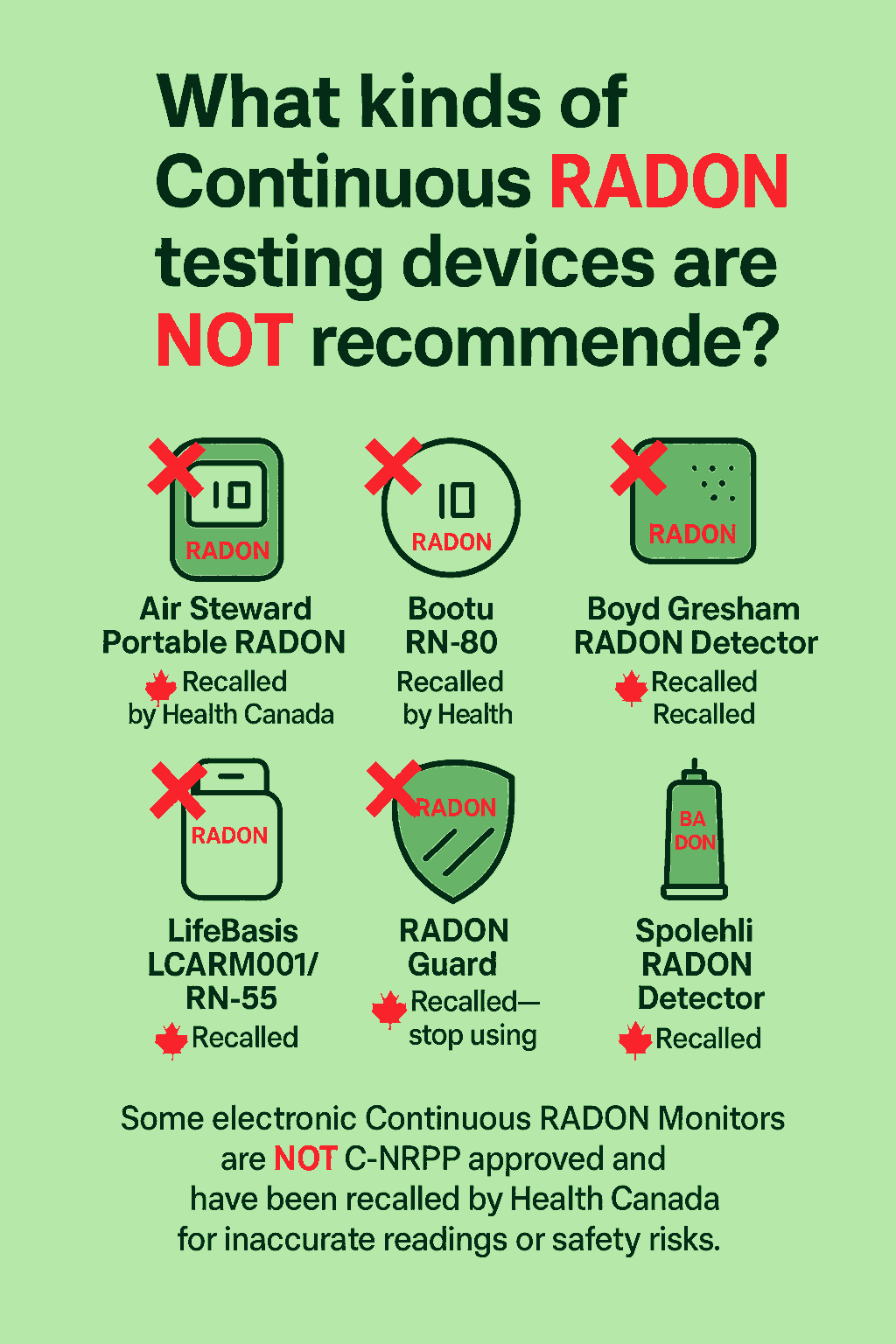
According to the C-NRPP 2023 Consumer Grade Electronic Device Report, several electronic RADON monitors are not approved for use in Canada.
Some of these devices were even recalled by Health Canada due to inaccurate RADON readings or safety concerns.
Not approved or recalled devices include:
- Air Steward Portable RADON Monitor (recalled by Health Canada)
- Bootu RN-80
- Boyd Gresham RADON Detector (recalled by Health Canada)
- CRADTEC PRM-02H, PRM-03H
- Funny Kitchen HRDM-02 (recalled by Health Canada)
- HAKINAKU Smart RADON Gas Detector
- Hanchen Home RADON Detector (recalled by Health Canada)
- INKBIRD Home RADON Meter, INK-RD2
- LifeBasis LCARM001, RN-55 (both recalled by Health Canada)
- RADON Guard (recalled by Health Canada - stop using and dispose immediately)
- Spolehli RADON Detector (recalled by Health Canada)
For more information, visit the Health Canada recalls database at
👉 recalls-rappels.canada.ca
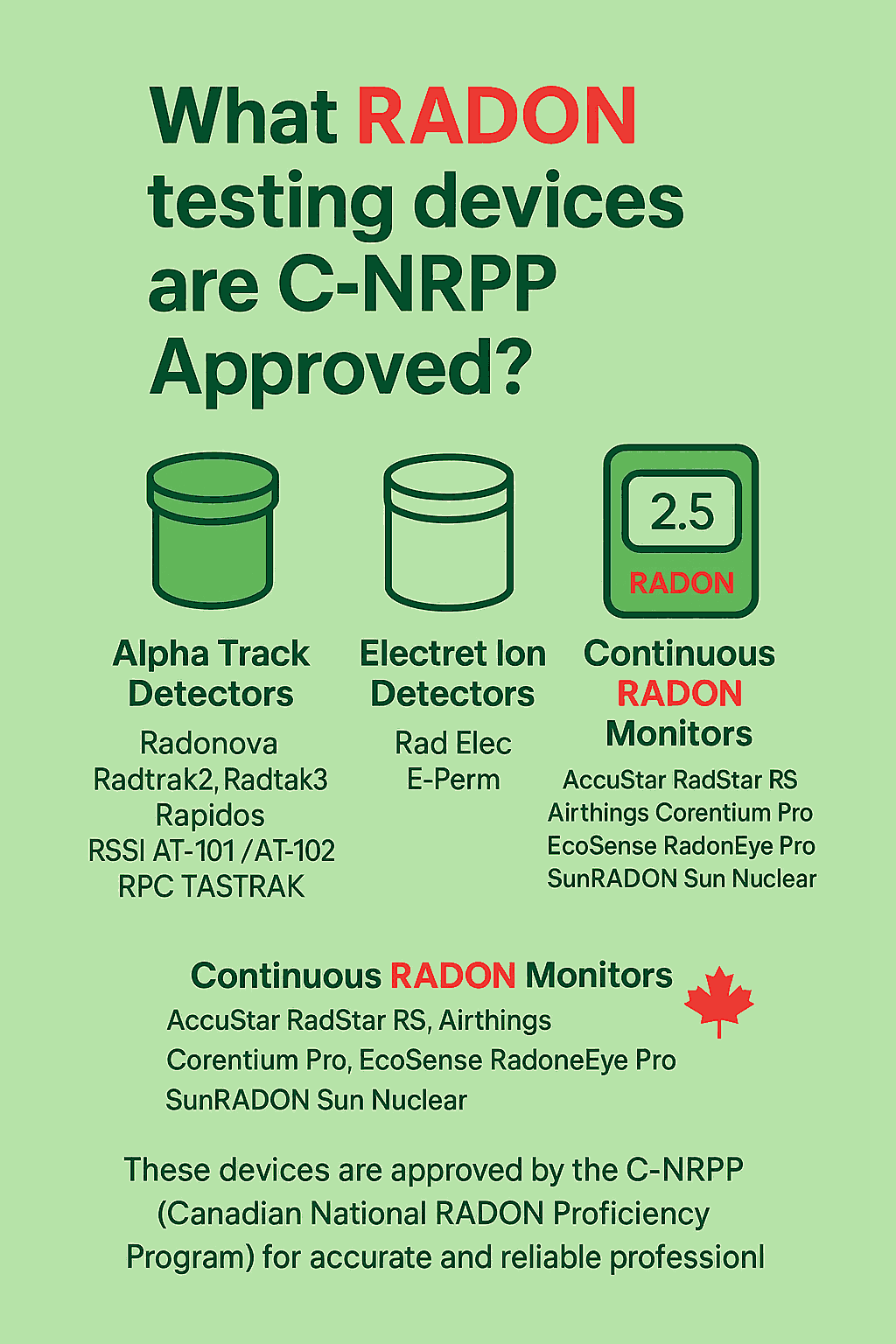
The C-NRPP (Canadian National RADON Proficiency Program) maintains a list of devices that are approved for use by certified RADON Measurement and Mitigation Professionals. These devices are tested for accuracy, reliability, and long-term stability.
Approved device types include:
- Alpha Track Detectors - long-term test kits
- Electret Ion Detectors - passive detectors for short to medium testing
- Professional - Grade Electronic RADON Monitors - continuous monitoring instruments
Examples of approved devices:
- Alpha Track: Radonova Radtrak2, Radtrak3, Rapidos, RSSI AT-101/102, RPC TASTRAK
- Electret Ion: Rad Elec E-Perm
- Continuous Monitors: AccuStar RadStar RS, Airthings Corentium Pro, Durridge Niton Rad7, EcoSense RadonEye Pro, Radonova SPIRIT, SARAD Radon Scout CRM, SunRADON Sun Nuclear
For the full list, visit the official C-NRPP Approved Device Directory:
👉https://c-nrpp.ca/approved-radon-measurement-devices/
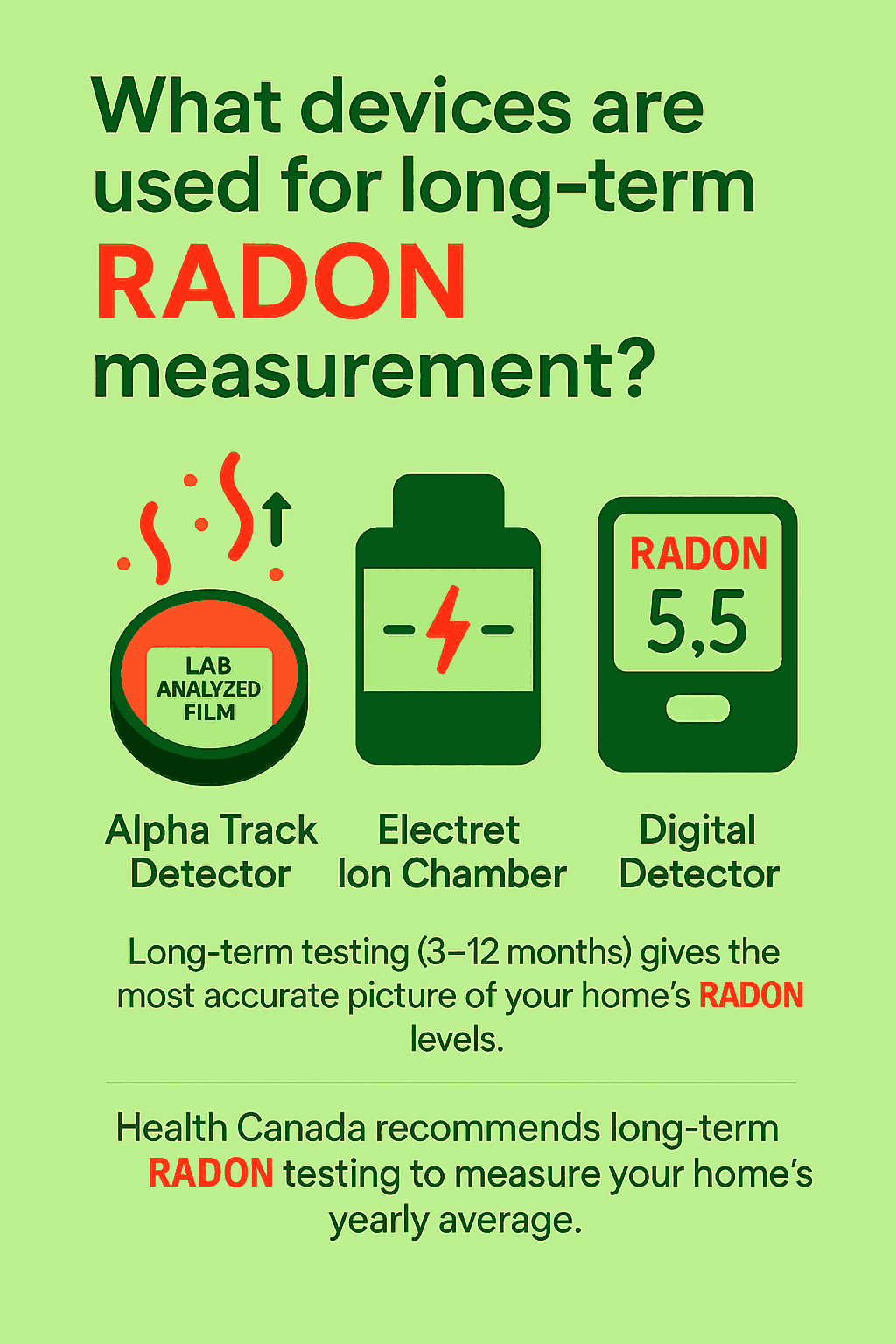
Long-term RADON testing (3-12 months) gives a more accurate yearly average. Common devices include:
- Alpha Track Detector: The most widely used in Canada; it collects RADON particles that leave marks on film, later analyzed in a lab.
- Electret Ion Chamber: Measures changes in electrical charge over time to determine average RADON levels.
- Digital Detector: Continuously monitors and displays RADON levels, showing both short-term and long-term averages
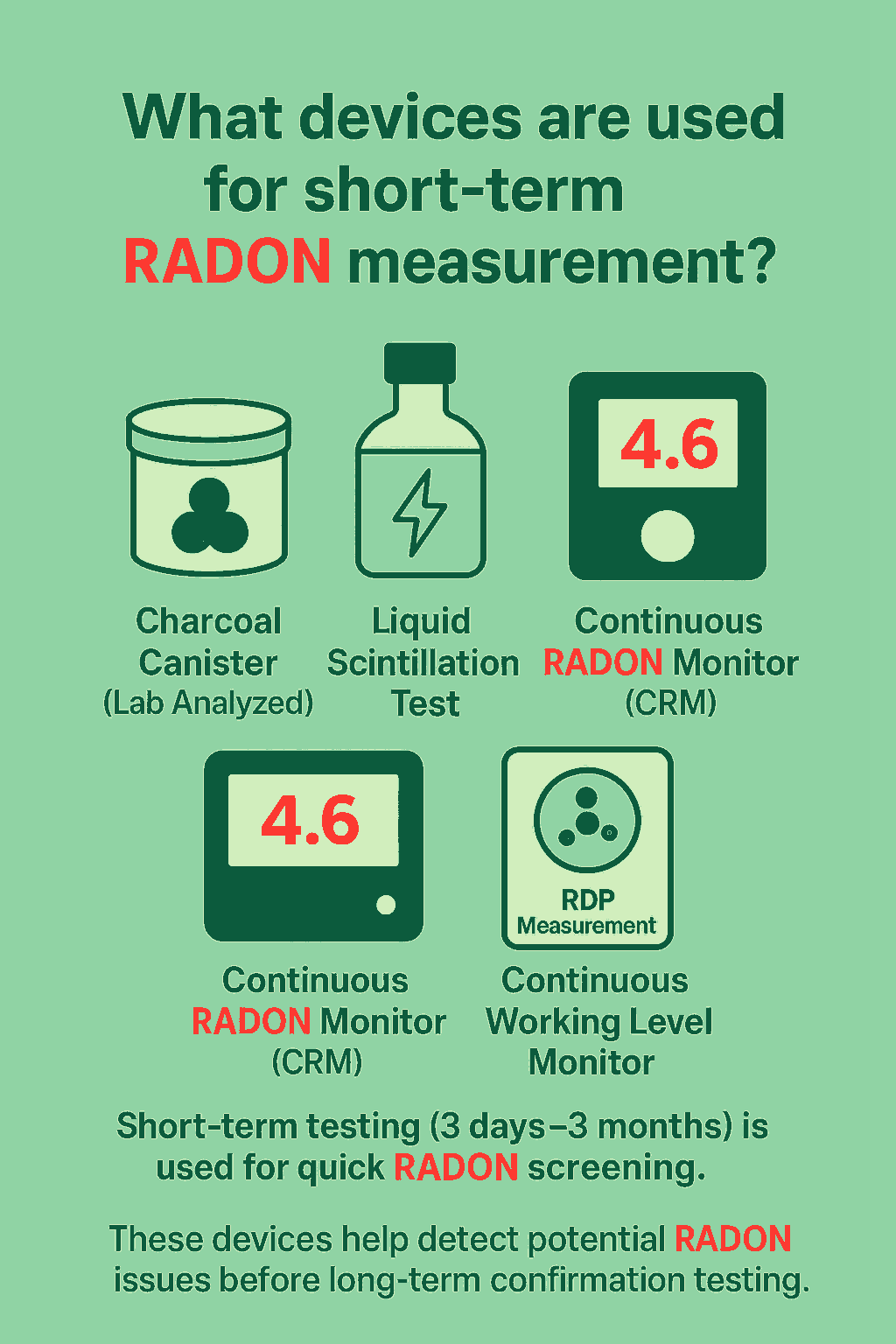
Short-term RADON tests (3 days to 3 months) are used for quick screening to see if your home might have high RADON levels. Common devices include:
- Activated Charcoal Adsorption: Small canisters with charcoal that absorb RADON from the air; later analyzed in a lab.
- Charcoal Liquid Scintillation: Similar to charcoal adsorption, but analyzed using liquid scintillation counting.
- Electret Ion Chamber: Uses an electrically charged disk that loses charge as RADON decays; suitable for both short- and long-term testing.
- Continuous RADON Monitor (CRM): Electronic device that continuously measures and records RADON levels in real time.
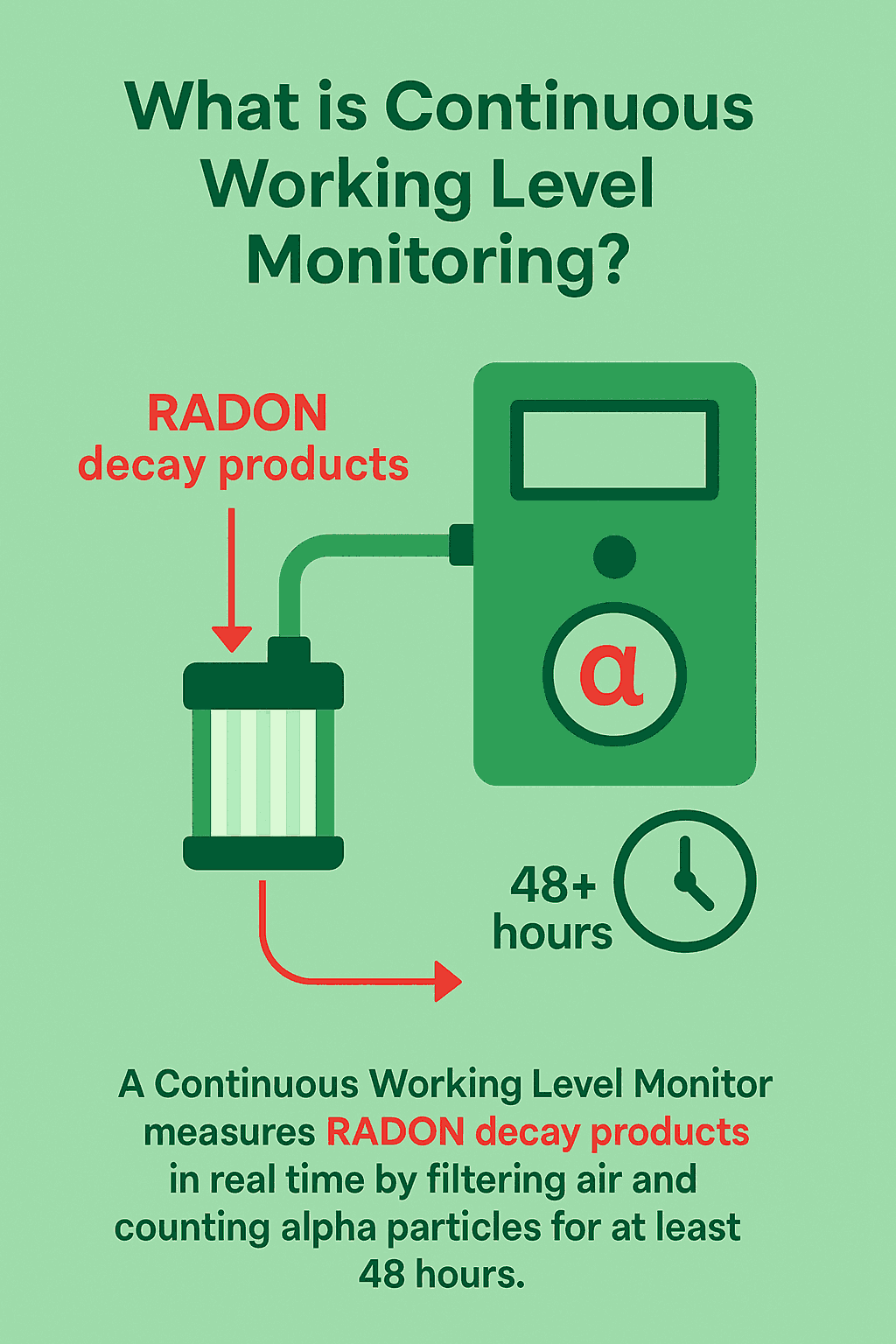
- Continuous Working Level Monitor: Measures RADON decay products (RDPs) to assess potential exposure to radiation.
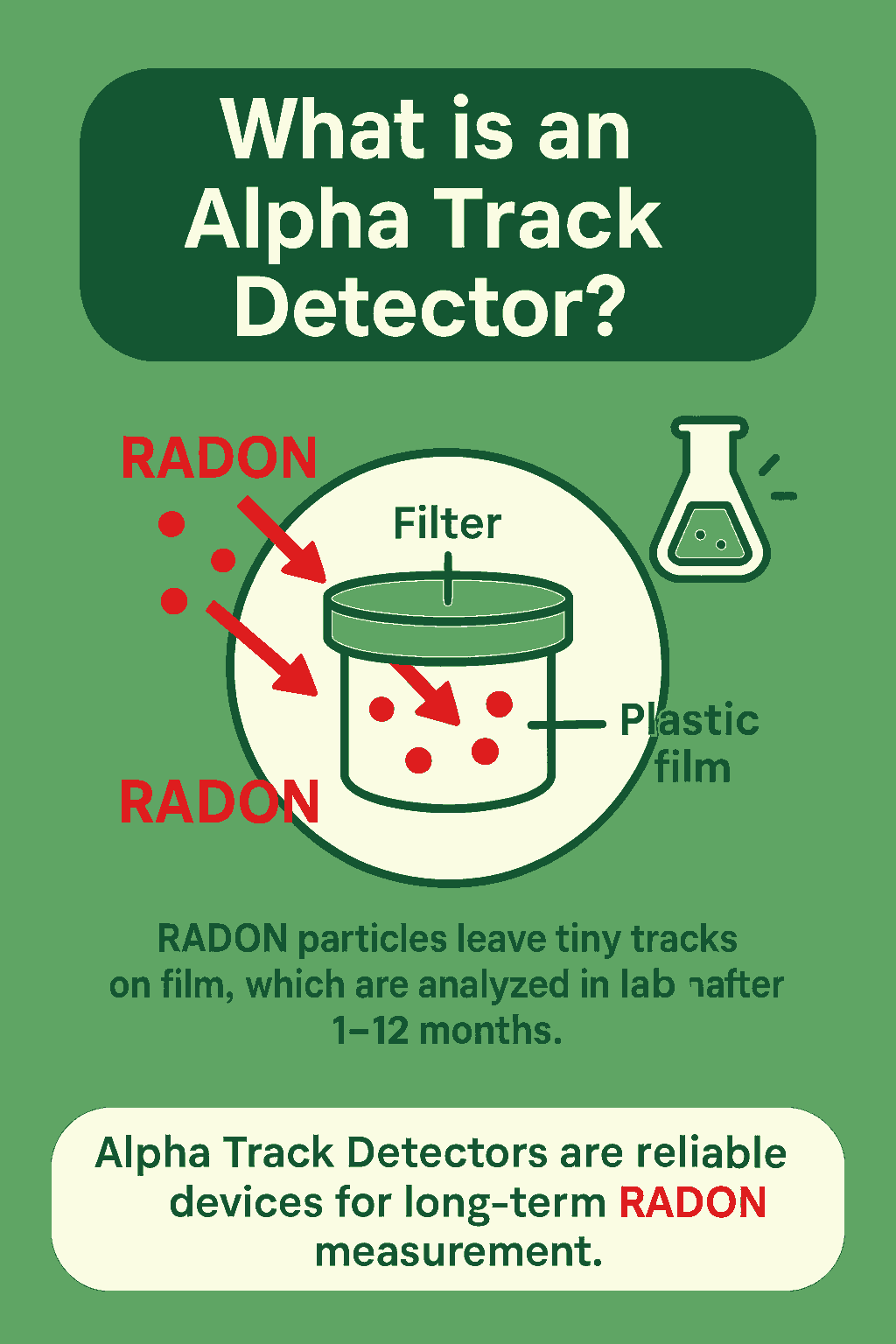
An Alpha Track Detector is a small container with a special plastic or film that collects RADON particles over time. Air enters the device through a filtered opening, and when alpha particles from RADON hit the film, they leave tiny marks called “tracks.” After the test period (usually 1 to 12 months), the detector is sent to a lab, where these tracks are counted to determine the average RADON level in your home.
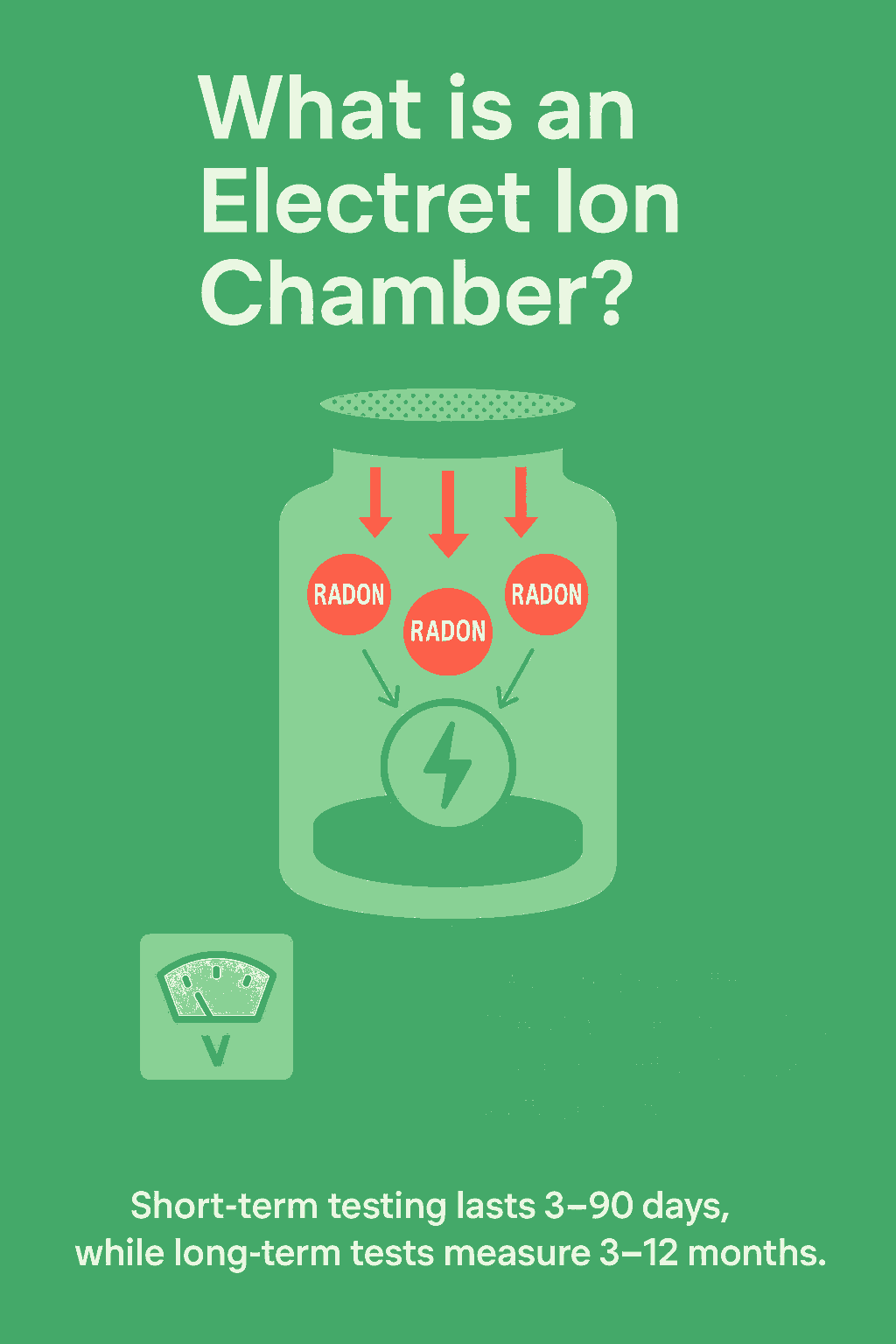
An Electret Ion Chamber is a plastic canister containing a small, electrically charged disk called an electret. During testing, RADON gas enters the chamber through a filter. As RADON decays, it releases particles that reduce the electret’s charge. The drop in voltage shows how much RADON is present.
Short-term tests last 3-90 days, while long-term tests can measure 3-12 months for more accurate results.
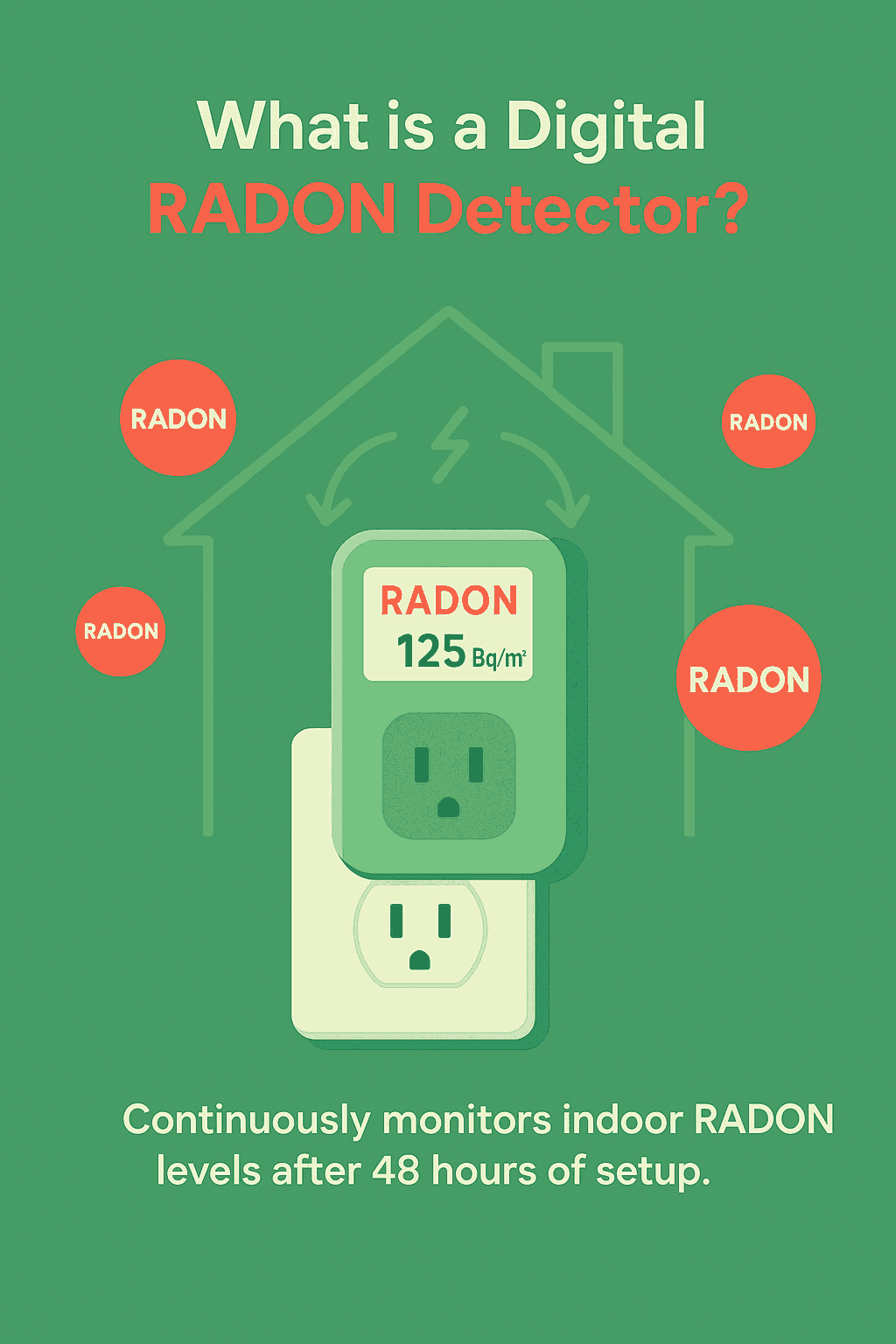
A digital RADON detector plugs into a regular wall outlet and continuously measures RADON levels in your home. After about 48 hours, it starts showing the average RADON concentration, helping homeowners easily monitor different areas over time.
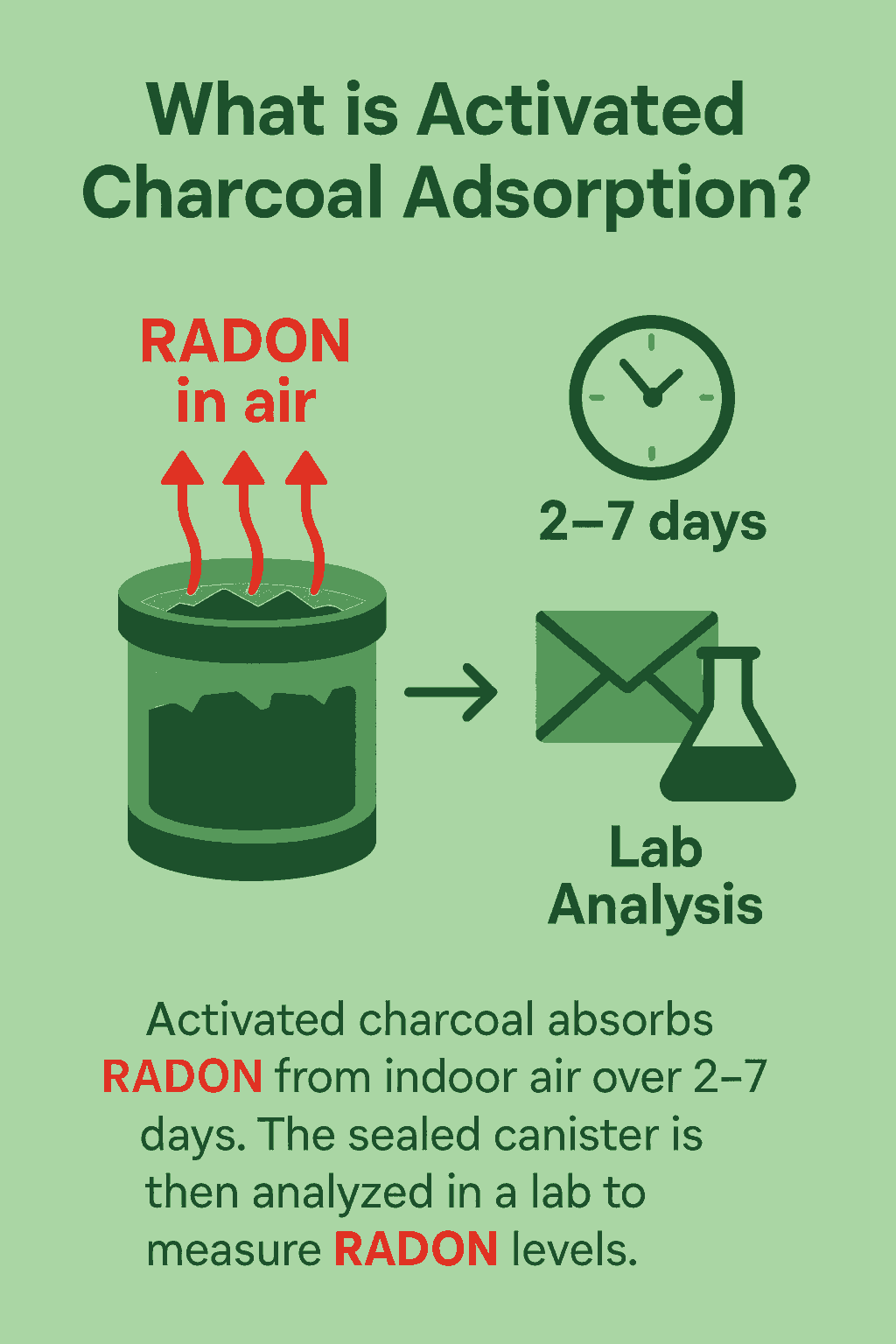
An activated charcoal RADON detector is a small canister filled with charcoal that naturally absorbs RADON gas from the surrounding air. Over a testing period of 2 to 7 days, the detector is left in place to collect RADON. Afterward, it is sealed and sent to a laboratory, where the amount of RADON captured in the charcoal is analyzed to determine the home’s average indoor RADON level.
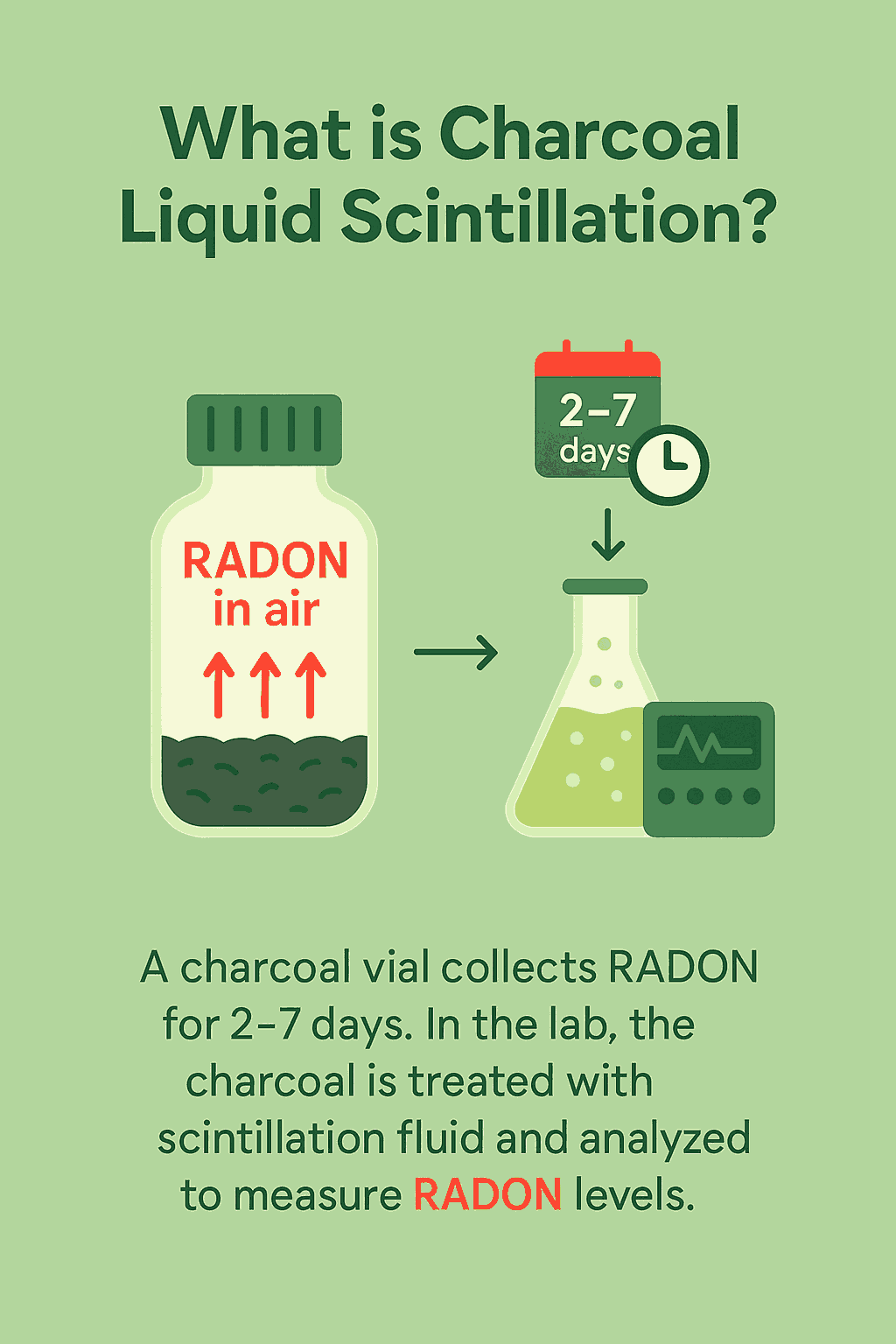
A charcoal liquid scintillation test uses a small vial of activated charcoal to collect RADON from the air over a few days. After 2-7 days, the vial is sealed and sent to a lab, where the charcoal is mixed with a special scintillation fluid and analyzed to measure the RADON level in your home.
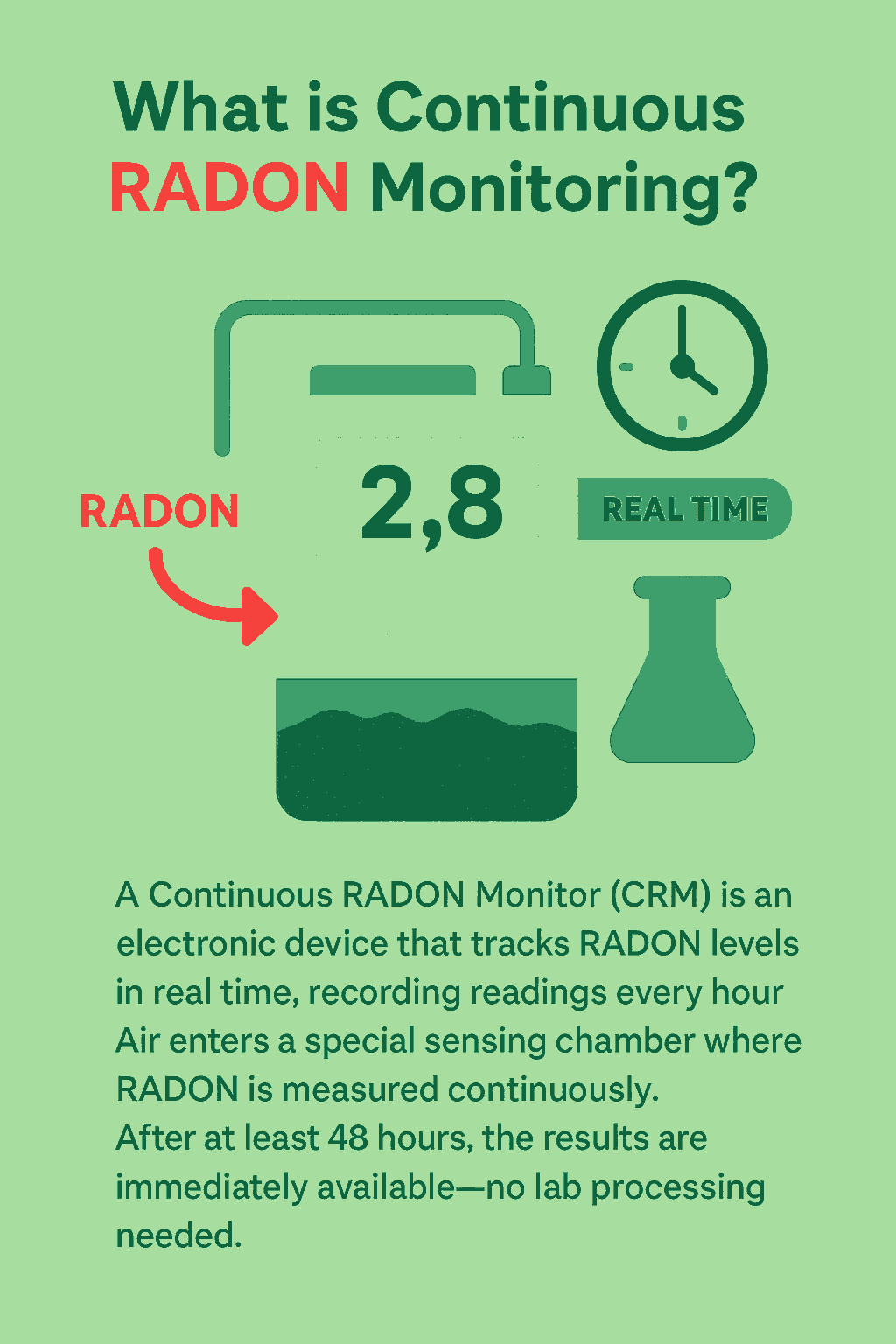
A Continuous RADON Monitor (CRM) is an electronic device that tracks RADON levels in real time, recording readings every hour. Air enters a special sensing chamber where RADON is measured continuously. After at least 48 hours, the results are immediately available-no lab processing needed.
A Continuous Working Level Monitor measures the radioactive decay products of RADON in real time. It continuously draws air through a small filter, where these particles are collected and counted to determine their concentration. The device runs for at least 48 hours and provides immediate results showing the level of RADON decay products in the air.
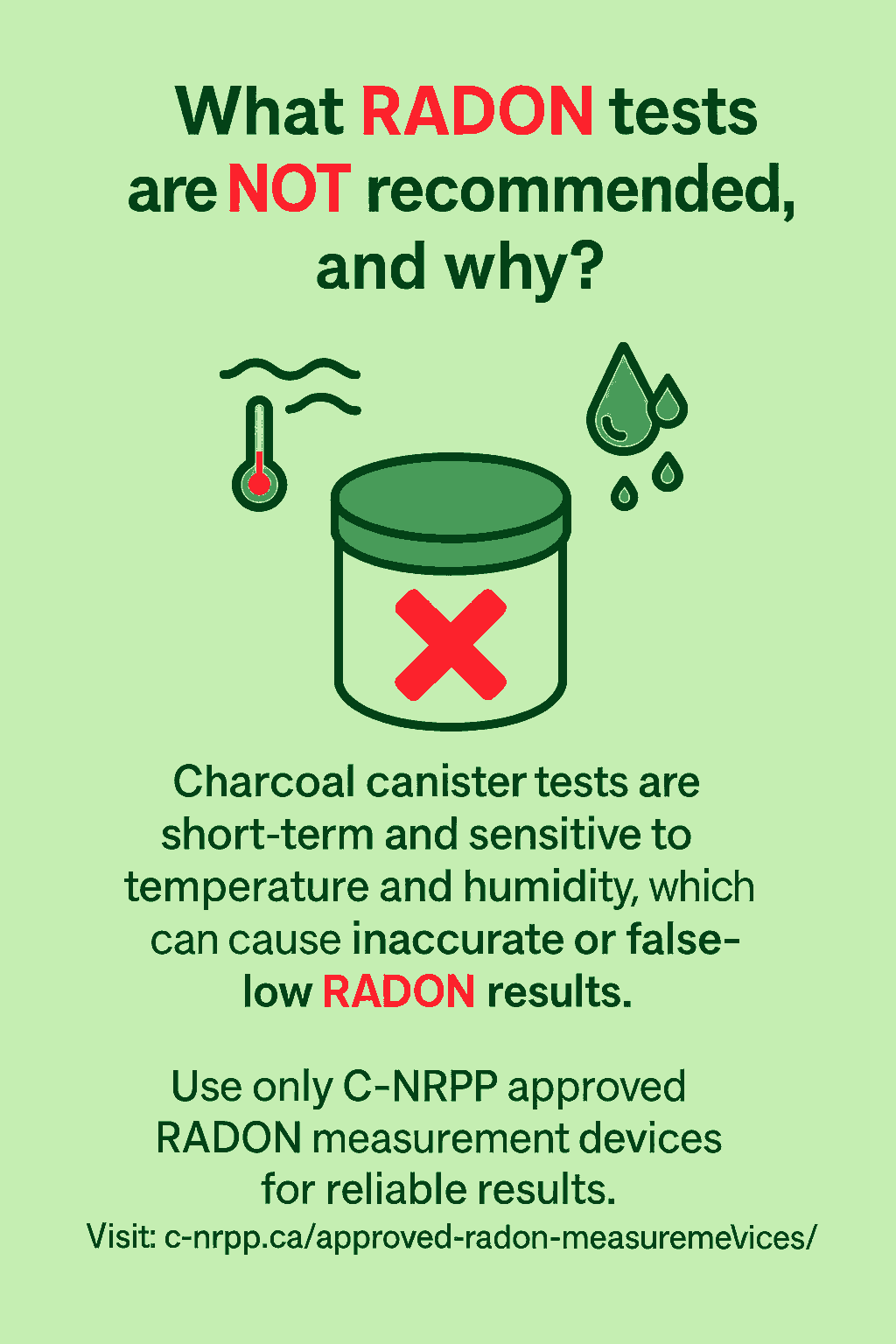
We do not recommend charcoal canister test kits, as they are short-term and can be affected by temperature, humidity, and other environmental factors. These conditions often lead to inaccurate or falsely low RADON results.